

Where The Water Tastes Like Wine Characters
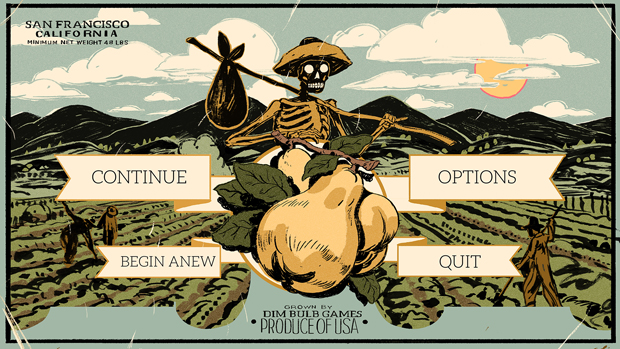
Where the Water Tastes Like Wine [official site] is a game about folk tales. It'south an anthology of sorts and brings together different writers as they pen characters to inhabit a hard state. There's this gloriously intense illustrated style which works alongside the soundtrack to requite me chills every time I run into the trailer or visit the website. I've included that trailer after the bound and then y'all tin can see what I mean, merely at that place's likewise a fabulism there – dark dreams and transformations are the game's hallmarks.
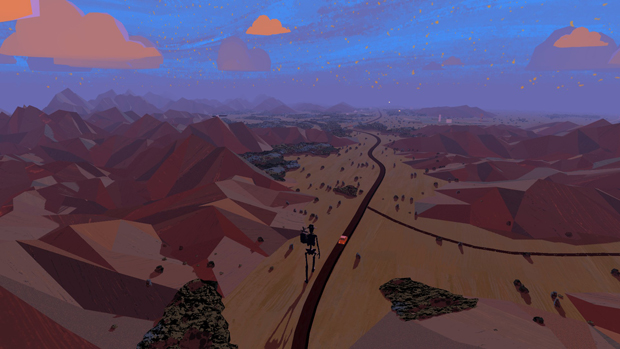
I played a tiny slice at GDC before this year with programmer, Johnnemann Nordhagen, peeping over my shoulder. Nordhagen was a co-founder of Fullbright but he's now creating Where The Water Tastes Similar Wine nether the aegis of Dim Bulb Games. The aesthetic was so evocative and so unusual in a game setting that we've been exchanging emails to talk more about it. An art feature is coming merely before nosotros get to that we needed to talk most folklore, the myth of America and the way stories repeat and recombine.
The game itself features a cast of characters whose stories class a kind of bleak American anthology likewise as an exploration of how folk tales are these fluid things with life cycles of their ain. With that in listen the exact course of the game'southward content is influenced past what the private writers for each character are interested in. But Nordhagen is the point from which these commissions and ideas initially flowed and his vision of the game is the unifying chemical element.
Given the game'south music, fine art and philosophy all seem then tightly bound to one another I ask what he was surrounding himself with equally he worked on the game.
"After Gone Home shipped, I took some time to figure out what was going on next for me," he says (Nordhagen was the sole programmer on Gone Habitation). " I had e'er wanted to travel a bunch, but had never really had responsibility-costless time to exercise so. So I spent six months backpacking around the world, trying to travel as much as possible over land and past boat. I was also tossing around ideas for what sort of game I might make - I wanted to make something that was my cosmos, since my whole career to that point had been working on other people'due south ideas."
On a train in the middle of Siberia was the signal at which he decided a game about travelling was in club. The aim was "to try to capture the trading of stories and experiences that you become with fellow wanderers". Friends have ridden the Trans Siberian Railway and I remember them talking about the feel of diverse kinds of sharing with fellow passengers. Aforementioned with the long journeys on American runway networks. It's a very different type of travel to near train rides in the U.k. – expansive and potentially beautiful and with a lot of time to kill.
"I've also long been a fan of American roots music - bluegrass, blues, jazz, folk, and I was listening to a lot of that. I dear the world described in those songs - solitary wanderers, unlucky gamblers, run-ins with the Devil, murder ballads, criminals, hard workers oppressed by the bosses - and I felt like a game where you got to explore that kind of world would be a neat thing to tackle," he adds. "From in that location it's a quick jump to the Nifty Depression, hobos and labor unrest, and I decided to kind of take the mythical and fantastical worlds that are independent in American folk songs and stories and wrap them around that period of history. And both because of the time period, and considering of the general mood of this genre of music, information technology needed to have a existent sense of sadness, of tragedy and struggle."
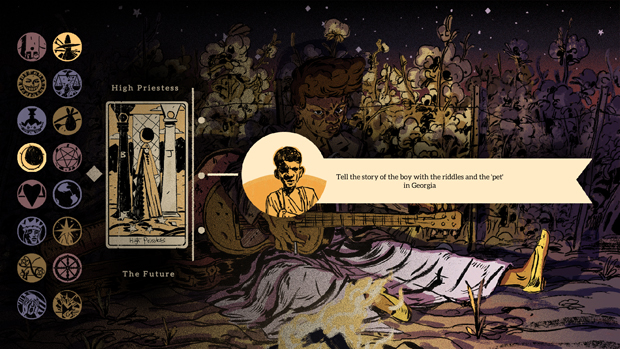
Combining the ii takes you towards the folk tradition where stories and songs get shared and recombined. "If yous listen to this music you start to hear the lines borrowed from one place or some other, and you tin see them crop up again and again. That's part of where the title of the game comes from - it'due south a line from various songs stretching back into the mists of folk history."
He shares me in on a playlist which swells and agitates around the "loftier lonesome audio". I listen to Sweetness Emma Barrett, Phil Ochs, John Lee Hooker, Pb Belly, Pete Seeger…
"I started making lists of the sort of characters 1 might encounter equally a wandering storyteller. And I started reading a lot of books and watching a lot of movies and TV nigh the era and about these sort of characters. Coal miners in the mine wars, the kids sent out to fend for themselves during the Great Depression, sharecroppers, Pullman porters - I read a lot of books! But it likewise started condign clear to me that while I could do the research on this, I wouldn't be the best person to tell all of these stories. I'one thousand not the right person to write about the spread of black civilization out of the south after the Civil War, or nearly the Long Walk of the Navajo. And I'chiliad also simply non a professional writer!"
That'south the point at which the game eased into being this anthology. As far every bit I understood it the stories were these distinct characters you encountered every bit you played, just I was interested in whether Nordhagen had tried to soften those edges between characters by passing them around in the manner of the folk music and lore we'd touched on already.
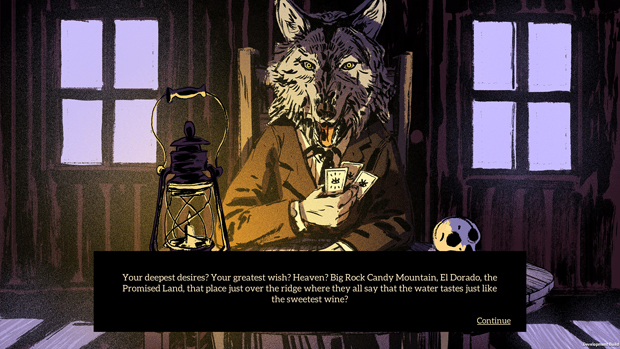
I ask whether he was tempted to run them through that prism of other people's retellings and reshapings to run across which parts stuck effectually.
"It seemed tough to do that with some of the stories that people were writing, and some of the historical backgrounds we were investigating," he replies. "The story of the army of veterans who marched on Washington during the Great Depression, or the thought that the U.s.a. military had dropped bombs on coal miners, or the forced relocation of the Navajo - turning them into legends didn't experience right, both because they were real tragic history and also because they were such good stories to brainstorm with."
Instead the actor is the story collector. You take on the job of the personification of folklore later losing a poker game with the wrong entity and thus it's your responsibility to pass these stories from identify to place. Nordhagen refers to it as a Greek myth/Terry Pratchett kind of thought – "there's an actual person responsible for doing this, for spreading tales and watching them grow. And also that this is a necessary office, so that the Idea of America can persist, through these stories. Basically that America is more a myth than anything else, and what kind of myth it is is determined by the stories you're spreading."
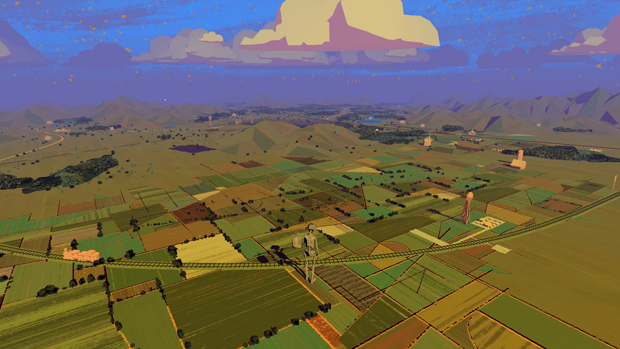
We'll get to America every bit a myth properly in time but first allow's go back to the game's title. When I first heard it information technology sounded familiar in that way where information technology felt like a quote I could never quite attribute – maybe a bible poesy or a legend or… some other established shape in a shared consciousness which we vocalism in variations over centuries.
"Information technology was a line I knew from a song, originally, and and so one day many years agone I was reading 'Sometimes A Swell Notion' and there it was again, the aforementioned line. I started digging effectually to find out which had come up first, the volume or the song, and I institute out that the history of this phrase, "where the h2o tastes similar wine" only goes back forever, and has been passed effectually from identify to place in a very folk-civilization manner.
"Actually, when I was doing research for the game I read this book past Zora Neale Hurston, chosen Mules and Men. It'south nigh her journeying back to where she grew up to collect the folklore and stories of the people around in that location. And then just casually in the centre of this book a person talks nigh 'Polk Canton, where the water drinks like cherry wine' and I basically fell out of my chair. I looked it up, and Polk County is immediately side by side to the county where these poor, powerless blackness folks are having this conversation, and that too really struck me - the thought that such a place can be so close, the important thing is that it's inaccessible. The side by side county over can exist mythical, if you can't go there easily!"
Vignettes make upward a lot of Where The Water Tastes Like Wine. The accent isn't on the outcome of deportment exactly, just on what kind of story yous get as a result:
"You might make choices that lead to this being a love story, instead of a tragedy. Or a story well-nigh traveling, instead of a story about memories. The player collects those stories, and that's your currency for talking to the characters - y'all trade them a story about love, and in return they tell y'all something near love from their own life or experience."
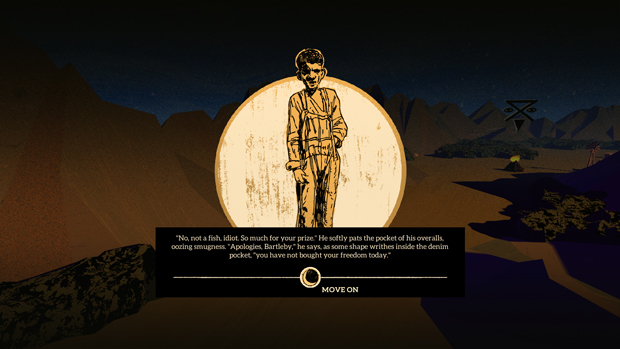
As the folklore personification tells and spreads these tales the idea is that you lot'll hear them back merely altered every bit if you lot're playing a longer-course version of Telephone and y'all can scoop those into your collection too.
"We have a story about buying a violin from a family, although the girl who owns the violin is violently opposed to this thought. You tin can tell that story, and so it'll grow larger. When you hear it back it might be about a violin that could only be played past the truthful owner. Or about a cursed violin, forever haunted by the ghost of the original violinist."
But to get back to the specific characters, "You can also tell the life stories of the people you meet, but those are sort of treated as inviolate - they're True stories, and that's more valuable to yous in your role, and to the myth of America."
The idea of other people influencing the character stories does come up just it's in the class of Nordhagen offering a kind of multimedia mood board to the authors to guide the procedure a picayune. To take the character of Ray, the basic thought was that he was a cowboy mourning the death of the Wild West but that would then get refined via movies similar Hell or High Water and Dead Homo and Butch Cassidy and the books of Cormac McCarthy and Nordhagen would try to distill that sense into stories and references and feelings.
"Jolie Menzel wrote Ray - she's a narrative designer at Ubisoft and has worked at Telltale and she's peachy at this," he says. "She took my interpretations of that menses and McCarthy and all the rest and created this graphic symbol from it, with her own twists and additions to who he is, fleshing him out as a real person.
"It turns out he's not just mourning the expiry of the West in some abstract way, but that information technology's specifically related to the inroad of Federal land and the way big swathes of the desert were turned into testing grounds for nuclear weapons. He's partly this tragic poetic figure, partly a libertarian asshole, and partly an eco-terrorist. It's wonderful considering I can run across the shape of the character as I envisioned him, merely it's changed and grown and become deeper and richer through her interpretation."
For me there too the idea than an audience will feed into this bike of sharing and reshaping if they tell friends virtually what they're playing.
But to return to the thought of America as a myth, it'south a way of thinking about the United States which I'm familiar with in some sense but I e'er come to it as an outsider. I tin can read about elements which stand for bits of it – these sweeping and problematic doctrines like manifest destiny – or see the emotional sway that words like veteran exert but I'thousand not part of the nation which formed from that particular set of ingredients and convulsions and politics.
I tell him that I'one thousand ambling towards a question that I don't quite know how to inquire but information technology's something like "How does the myth of America feel to you at the moment and has that changed as you worked on Where the Water Tastes Similar Wine?" And that'southward if it even feels like anything to start with.
"Oh gosh, yes. A lot has changed recently for us, hasn't it?" he replies. "It'southward terrible. And looking dorsum on this history, existence steeped in this, it merely makes me realize that America is actually repeating the mistakes of the past once again and again. That the same themes are coming up, and have been for a while.
"This game has always been nearly struggle, and about how at that place are people on the edges of order that get left backside or mistreated. All of the characters the histrion meets fit into that category. And that struggle to not exist crushed by the mainstream, by the government or by your fellow citizens - I hateful, I think nosotros're wrestling with that at present in a huge way.
"When I read about Reconstruction, and the way that black sharecroppers were treated in the s - they weren't slaves any more than, technically, but they immediately got taken reward of by these payment schemes that kept them in debt forever. And you can look around at present and encounter the same tools beingness used, the same economic chains, and realize that few people ever really escaped that.
"The aforementioned with the way the Navajo and actually all natives were treated - Standing Rock and the remainder is just a continuation of policies that were put in place long agone. The way Dustbowl refugees were turned back at the border to California. The bracero program that brought in farmworkers from Mexico only to lead to the horrible and racist "Performance Wetback" to deport them and their descendants.
"I theme that came up with a lot of these characters is political and social solidarity, though. I wasn't intending this game to be overtly political - I wanted to represent these stories and these people, but it turns out the Unions and similar structures were huge centers of power and really the but mode people were able to fight back against these oppressions. Many of the characters represent organized labor of ane sort or another, and others vest to advertising-hoc political blocks that got power through their numbers.
"Anyhow, I gauge what I've seen while researching this game is that the myth of America has always been 'a shining prevarication' as one character calls it. I mean I knew that going in, and as a white man I'm already shielded from a lot of the history that would accept pierced that lie. But I think that at present, peradventure, that prevarication is unraveling a flake. And I think it's partly due to people sharing their stories more effectively. Nosotros can come across that 'the American Dream' was only bachelor to a certain kind of person, and usually it wasn't even available to them."
But in keeping with the ubiquitous-but-ephemeral phrase Where The H2o Tastes Like Wine, paradise isn't a single place, it's a thing you glimpse in these valuable, transcendent moments during a regular, dreary life.
"I do gather hope from these times in the past, from immigrant and black miners joining the mine strikes instead of scabbing, from the Sharecroppers' Union and the Brotherhood of Sleeping Automobile Porters, the Bonus Army, and things similar that," says Nordhagen.
"I run into these times when people were able to make their lives ameliorate, to win and to get closer to The Dream."
Where The Water Tastes Similar Wine is due out subsequently this yr.
Disclosure: Regular RPS contributors Cara Ellison, Leigh Alexander and Emily Short have all written for the game.

Where The Water Tastes Like Wine Characters,
Source: https://www.rockpapershotgun.com/where-the-water-tastes-like-wine
Posted by: williamsbrin1942.blogspot.com
0 Response to "Where The Water Tastes Like Wine Characters"
Post a Comment